Why Board Management is critical for Non Profits
This article explores why strong board governance is essential for not-for-profits, highlighting how effective boards safeguard mission, ensure compliance, manage finances, and provide strategic leadership. It also examines common governance models and offers practical steps—like adopting clear policies, diversifying board composition, and setting term limits—to strengthen accountability, fundraising, and long-term impact.

Published by
John Williamson
on
Mar 3, 2025
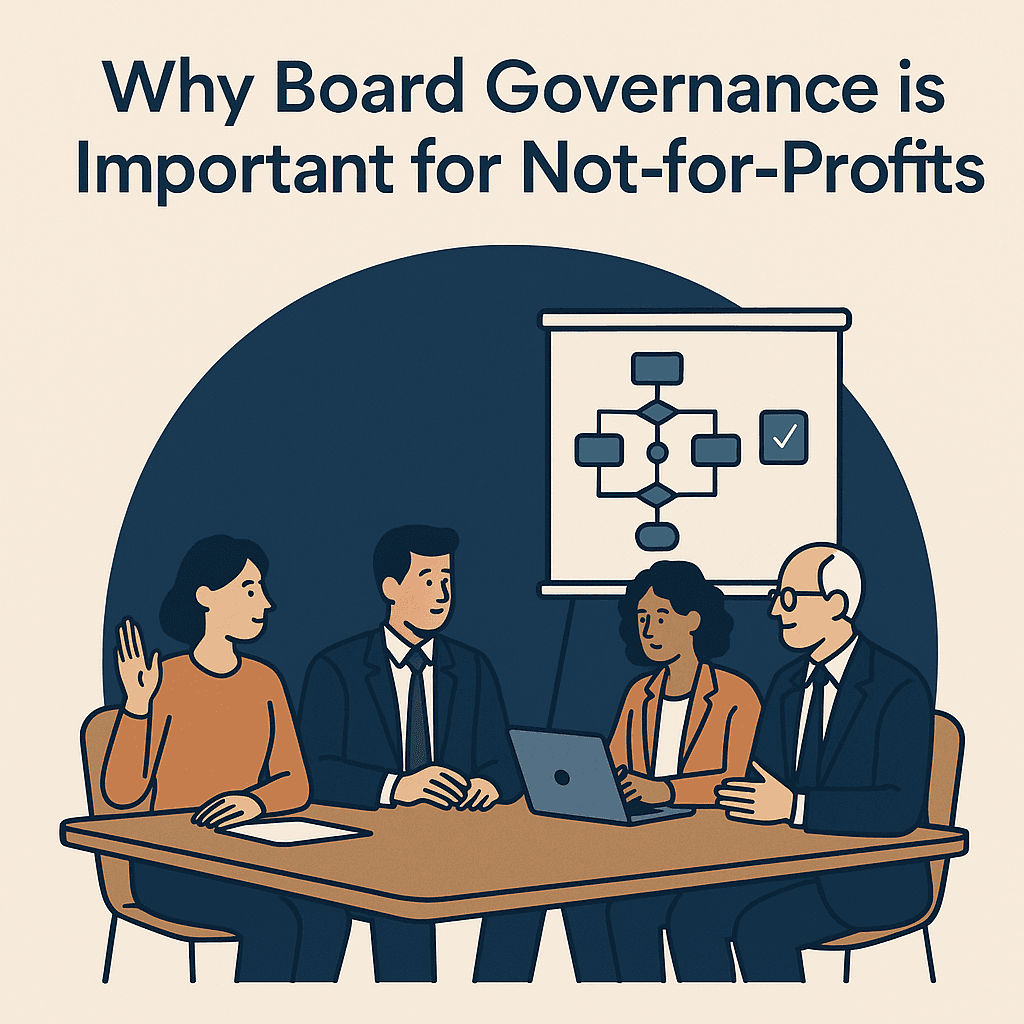
Why Board Governance Matters
Not‑for‑profits (NFPs) operate in a landscape defined by public trust. They use donations and grants to address social, cultural and environmental issues, often under intense scrutiny from regulators, donors and the communities they serve. Strong governance — the system of policies, processes and people that oversee an organization — ensures that a charity fulfils its mission ethically, legally and effectively. Without effective governance, even well‑intentioned organizations can fall into financial mismanagement, mission drift or reputational damage. Below, we explore the core components of board governance, why they matter and how NFPs can strengthen their boards to create lasting impact.
Understanding Board Governance
Board governance refers to the systems and structures through which a nonprofit’s board of directors steers the organization. It differs from day‑to‑day management; managers “steer the boat” while board members climb into the crow’s nest to provide foresight, oversight and insight. As the National Council of Nonprofits notes, board members adopt sound, ethical and legal governance and financial management policies, ensure adequate resources for the mission, and hire and supervise the chief executive. Boards act as fiduciaries — trustees who must put the interests of the organization above their own. They serve as ambassadors and advocates, providing guidance on culture, strategic focus, effectiveness and sustainability. Legal experts commonly describe three core duties:
Duty of Care – Board members must prudently use assets (people, property and goodwill) and ensure proper oversight.
Duty of Loyalty – Members must ensure the nonprofit advances its mission, avoid conflicts of interest and make decisions in the best interest of the charity rather than themselves.
Duty of Obedience – Members must ensure the organization obeys laws and regulations, follows its bylaws and adheres to its stated purpose.
These duties are not just legal formalities; they underpin trust with donors, regulators and the communities served. A board that neglects them can face lawsuits, tax penalties or loss of public support.
Core Responsibilities of an NFP Board
While specific needs vary by mission and size, most nonprofit boards share several core responsibilities. A strong board serves as the governing body that holds ultimate responsibility for the organization’s actions and well‑being. The article summarises key functions:
Mission Stewardship: Boards act as custodians of the mission, ensuring all programs and expansions align with the organization’s purpose. Mission drift – when an organization deviates from its purpose – can erode donor trust and effectiveness.
Governance and Legal Oversight: Boards ensure compliance with laws and regulations, uphold ethical practices and adopt sound policies. This includes managing conflicts of interest, managing risk and maintaining good standing with tax authorities.
Strategic Planning and Leadership: Boards set long‑term goals and collaborate with executive leadership to establish priorities, monitor progress and make major decisions about programs and partnerships. They look beyond daily operations to consider future opportunities and threats.
Financial Oversight: Boards safeguard the organization’s financial health, review budgets, monitor cash flow and oversee audits. Members should understand financial statements and ask questions about resource allocation.
Executive Oversight: Boards hire, support and evaluate the chief executive and, if necessary, replace them. The right leadership sets the tone for culture, operations and fundraising.
Fundraising and Resource Development: Board members should lead by example with personal giving and help expand the donor base. All members should support fundraising efforts through outreach and participation.
Advocacy and Ambassadorship: Boards help build awareness and support by representing the organization in the community and building relationships with funders, policymakers and stakeholders.
Policy Adoption and Disclosure: Boards adopt policies to promote transparency, including conflict‑of‑interest, whistleblower, document‑retention, gift acceptance and joint venture policies. They also approve executive compensation and ensure minutes of meetings and key documents are kept councilofnonprofits.org.
In addition to these functions, boards must review an organization’s Form 990 (or equivalent filing) before submission, disclose recent returns to the public and complete annual conflict‑of‑interest questionnaires. These practices promote transparency and accountability.
Fiduciary Duties and Financial Management
The term fiduciary implies a relationship of trust. Board members act as trustees for an organization’s assets and must exercise due diligence to ensure the nonprofit is well‑managed. According to Foundation Group’s 2024 article, board members must remain objective, responsible and honest, always acting for the good of the organization rather than personal benefit. They have a responsibility to ensure all funds are handled transparently and compliantly.
A central part of fiduciary duty is budgeting. Boards should set the annual budget and sign off on expenditures. Delegating budgeting to committees is acceptable, but the board should always approve the final numbers. Lack of a written budget or board oversight constitutes dereliction of duty and does not relieve members of financial responsibility. Boards also establish compensation guidelines and ensure that salaries are reasonable, tied to job descriptions, comparable to similar positions and within the organization’s means. Executive compensation is often scrutinized; boards should document how they determine pay to avoid excessive or inappropriate compensation.
Proper accounting and reporting practices are essential. Boards must ensure the organization produces accurate financial statements, files tax returns on time (such as Form 990 in the United States) and follows compliant bookkeeping practices. Investing is permissible, but the Prudent Man Rule requires that investments not be excessively risky and balance risk and return. Boards must also oversee the handling of funds, ensuring that at least two independent people are involved in money handling and accounting to prevent fraud or misuse.
Implementing good governance practices also means maintaining corporate minutes for board and committee meetings and adopting written policies — such as conflict‑of‑interest, whistleblower and document‑retention policies — as flagged on Form 990. Document retention policies ensure that key documents are preserved or destroyed appropriately, while whistleblower policies protect staff who report wrongdoing.
Governance Models and Board Structure
There is no one‑size‑fits‑all governance model. Nonprofits may combine elements of multiple governance structures to suit their organization’s needs.
Advisory board model: An advisory board composed of industry experts provides guidance and professional services, helping the organization expand its reach, credibility and fundraising efforts. Advisory boards often exist alongside a governing board, offering expertise without formal authority.
Cooperative model: In this democratic structure there is no CEO; all members are at the same leadership level and make decisions by consensus. Each member shares responsibility and accountability for the organization’s mission.
Patron model: Board members primarily provide financial support and use their influence to help raise funds. They typically have personal wealth or connections and exert less influence over operations than members of advisory boards.
Policy (Carver) model: Developed by John Carver, this model delegates most authority to the CEO, allowing them to run the organization while the board focuses on policy, outcomes and oversight. Regular meetings between the board and CEO keep the board informed.
Management team model: Instead of hiring staff for functions such as human resources, fundraising and planning, the board divides itself into department‑like committees to oversee those areas. This model is common when resources are limited or in early‑stage nonprofits.
Many nonprofits blend or mix these models. For example, an organization might follow the policy model but form an advisory council to provide technical expertise or fundraising assistance. In addition to choosing a model, boards benefit from committee structures.
Board officer roles also create structure, that the chair leads the board and acts as a partner to the chief executive, the vice chair provides succession for the chair, the secretary maintains records and minutes, and the treasurer oversees finances. Clear roles help distribute responsibilities and ensure accountability.
Building an Effective Board
Even when the legal duties and structures are in place, board effectiveness hinges on people and culture. The Bridgespan Group reminds us that effective boards must go beyond satisfying oversight responsibilities; they also provide strategic support, raise funds and build community support. In its research, Bridgespan identified five factors that enable effective board leadership:
People: Board members’ skills and assignments should align with the organization’s needs and their own interests. This alignment requires understanding what skills are needed (financial expertise, legal knowledge, lived experience, fundraising connections) and recruiting accordingly. It also means knowing when to exit board members who no longer fit the needs.
Culture: Effective boards foster an atmosphere of trust and respect where open debate and questioning are encouraged. High participation, constructive dissent and mutual respect lead to better decisions.
Decision‑making Processes: Boards and the executive director must have a shared view of which decisions require board approval and which are delegated. Clear decision‑making processes and agendas prevent confusion and ensure focus.
Structures and Information: Board size, representation, committees and meeting frequency should enable meaningful participation. Boards need timely information at the right level of detail; too much information can be overwhelming, while too little undermines oversight.
Dialogue and Improvement: Tools such as checklists and surveys help identify gaps, but real progress comes from open, productive dialogue among board members about their role and priorities.
Setting term limits and rotating leadership to infuse new perspectives; fostering ongoing education through site visits, presentations and conferences; providing clear expectations for attendance, giving and committee work; conducting regular self‑assessments; making meetings purposeful and strategic; and celebrating contributions.
Purposeful meetings might use mission moments—brief stories or videos highlighting program impact—to refocus the board on mission before decision‑making. Rotating committee chairs and term limits prevent stagnation and burnout.
Research also underscores the value of diversity and engagement. Boardable’s 2025 guide notes that engaged boards are 17 % more likely to grow fundraising revenue year‑over‑year and 7 % more likely to meet their goals. Building a diverse, skills‑based board improves fundraising growth and constituent trust. Progressive boards pair recruitment with inclusive onboarding plans, assigning mentors and ensuring new members experience the organization’s work firsthand. Term limits (often two three‑year terms) help maintain an infusion of new perspectives and require planning for leadership succession.
Governance Across the Organizational Lifecycle
The governance needs of a nonprofit evolve as it grows. The Bonadio article observes that new or emerging organizations often have working boards that combine governance and operations. Board members may volunteer in hands‑on roles, help with initial fundraising and build community relationships. Founding boards often consist of friends or early supporters with specific skills like legal or financial expertise. As the organization matures, it must transition to a governing board focused on oversight and strategy rather than operations. This shift involves professionalizing operations, hiring staff and recruiting directors who can support sustainability and oversight.
In mature organizations, governance challenges may include preventing mission drift, ensuring long‑term sustainability and navigating changes in funding or regulation. The board must remain strategic and forward‑looking, avoiding complacency. Periodic board refreshment and self‑assessment help ensure relevance.
Benefits of Strong Board Governance
Investing in governance brings tangible and intangible benefits:
Legal compliance and risk mitigation: Boards that understand and fulfill their duties protect the organization from regulatory violations and lawsuits. Good governance practices, such as maintaining minutes, reviewing policies and having multiple people handle funds, reduce the risk of fraud or mismanagement.
Financial sustainability: Sound budgeting, oversight and prudent investment enable NFPs to weather economic fluctuations. Studies show that engaged boards are more likely to increase fundraising revenue.
Strategic clarity: Boards provide long‑term vision, align programs with mission and help organizations navigate complex decisions. They ensure that resources are allocated effectively and that new initiatives fit the mission.
Leadership and succession: Boards hire and support the chief executive, ensuring stability and resilience. Succession planning reduces disruptions when leadership changes occur.
Advocacy and relationships: Board members can open doors to funders, policymakers and community leaders, serving as ambassadors for the mission. Their networks build credibility and influence.
Community trust and reputation: Transparency, accountability and adherence to mission enhance public trust. Boards that adopt policies and disclose information demonstrate integrity, increasing donor confidence.
Organizational learning: Ongoing education, diverse perspectives and open dialogue foster innovation and continuous improvement. Boards that routinely assess their own performance identify gaps and adapt.
Steps to Strengthen Governance
Adopt written policies and maintain minutes. Ensure the board maintains minutes of all meetings and adopts conflict‑of‑interest, whistleblower, document‑retention, gift‑acceptance and joint‑venture policies Annually review and complete conflict‑of‑interest questionnaires, and document when policies are invoked.
Review executive compensation and Form 990. Approve the chief executive’s compensation and document how it was determined to avoid excessive pay. Have the full board review Form 990 or other regulatory filings before they are submitted.
Develop a one‑page fiduciary snapshot. Boardable suggests including a one‑page risk snapshot in every board packet summarizing cash flow, restricted funds usage and key deadlines. This early‑warning system helps boards spot problems before they become crises. Boards can also maintain a “red flag log” where members note questions or concerns for discussion at meetings.
Build a diverse, skills‑based board. Craft competency‑based job descriptions, identify gaps (cybersecurity, lived experience, policy advocacy, etc.) and recruit accordingly. Assign a rotating “diversity champion” to track progress and partner with affinity networks to broaden candidate pipelines. Pair new members with mentors and integrate them quickly into committees and site visits.
Implement term limits and succession planning. Consider two three‑year terms with mandatory breaks to ensure board refreshment. Maintain a composition matrix showing upcoming vacancies and desired competencies, and pair outgoing directors with incoming ones for mentoring.
Design focused agendas and purposeful meetings. High‑performing boards require each agenda item to support a strategic priority; items that do not go to consent agendas or staff handling. Time‑box each item, use consent agendas for routine approvals and share materials in advance. Start meetings with a mission moment — a short story or metric showing impact — to remind members why decisions matter.
Manage conflicts transparently. Conduct annual conflict‑of‑interest disclosures and document recusals in meeting minutes. Some boards use a coloured‑card system where members raise a card to signal a conflict, normalizing disclosure and reducing stigma.
Invest in education and self‑assessment. Provide orientation for new members, encourage attendance at conferences and board trainings, and schedule regular self‑assessment or peer reviews to identify improvement areas. Tools such as nfp hubs self‑assessment or third‑party surveys provide data, but real progress comes from dialogue and consensus on actions.
Embrace open communication and culture. Foster a culture of trust, respect and constructive debate. Board chairs should facilitate inclusive discussions, encourage dissenting views and prevent dominant members from overpowering others.
Conclusion
Board governance is not merely a bureaucratic requirement; it is the backbone of an effective, ethical and impactful not‑for‑profit. Boards act as fiduciaries, strategic partners, ambassadors and stewards of the mission. They navigate complex regulatory environments, ensure financial integrity, provide strategic direction, build relationships and lead fundraising efforts. In a sector where trust is currency, strong governance protects the organization’s reputation and ensures that every dollar and every decision advances the mission.
For nonprofit leaders, investing in governance means investing in people, culture and processes. It requires recruiting diverse talent, clarifying roles, setting term limits, embracing transparency, and prioritizing continuous learning and self‑reflection. The payoff is significant: compliant and resilient organizations, greater fundraising success, strategic agility and, most importantly, lasting impact for the communities they serve. Boards that take their responsibilities seriously become the driving force behind sustainable, mission‑aligned change. Now is the time for every not‑for‑profit to examine its governance practices, engage its board members and build the structures necessary to thrive.